



For years, standing out on LinkedIn was partly a production challenge. Professionals who could publish consistently, write clearly and present their ideas well had an advantage over those who remained invisible. Generative AI has weakened that advantage with remarkable speed.
A coherent post can now be produced in seconds. For me, the result is worrying. Yes, more content might not be a bad thing, but does the added value increase in parallel?
LinkedIn says content creation on the platform has increased by 14% year over year, while acknowledging that AI has made it possible to produce large quantities of low-quality material. The company is now reducing the distribution of generic posts, automated comments and attention-driven content that offers little original value. Its stated objective is not to punish people for using AI, but to distinguish between content that carries genuine perspective and content that merely resembles professional communication.
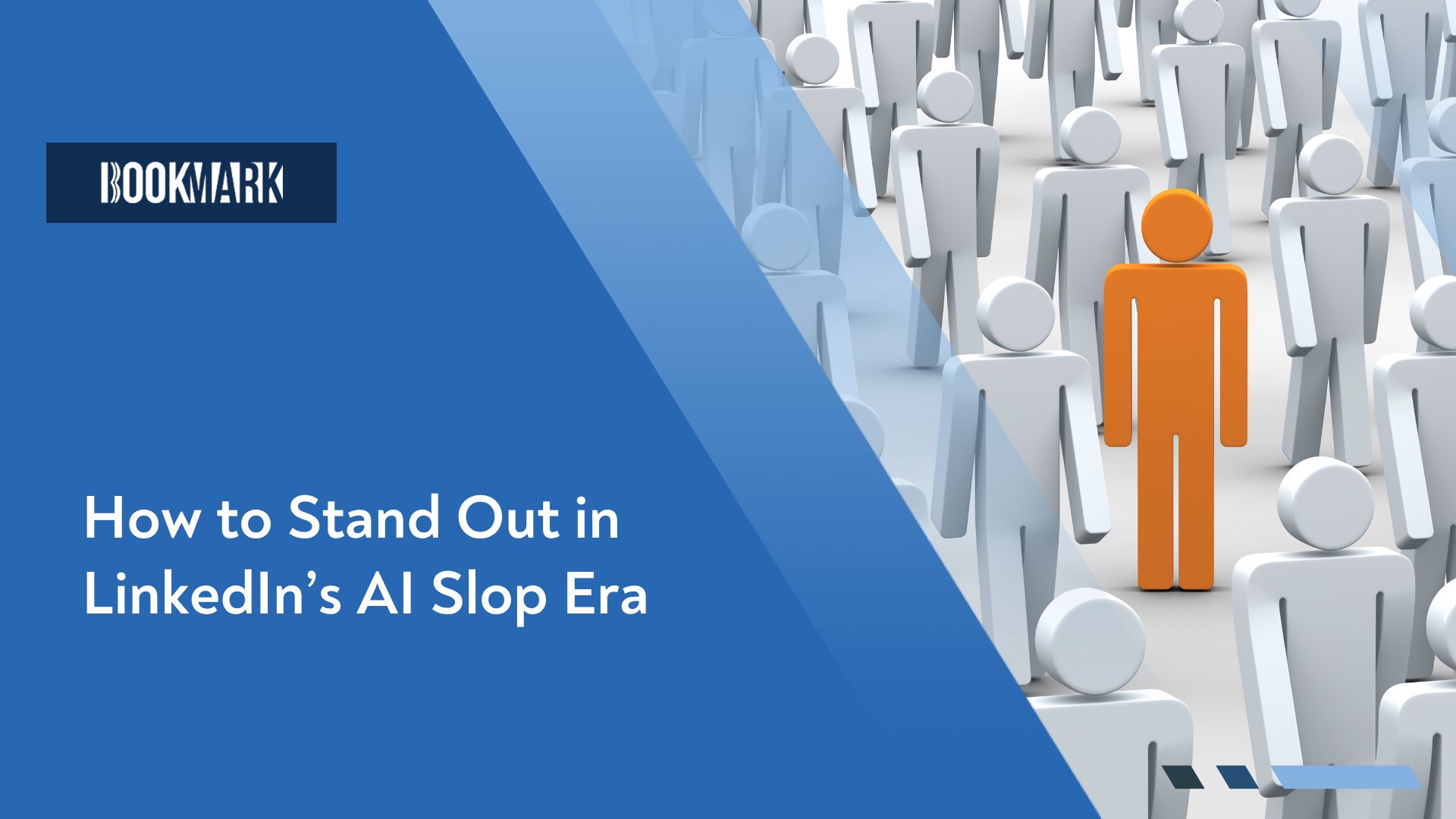
This creates a different competitive environment. In LinkedIn’s AI slop era, the central challenge is how to make human judgement visible.
AI Has Collapsed the Cost of Looking Insightful
Generative AI did not create generic professional content. LinkedIn already had its share of recycled leadership lessons, vague career advice and carefully neutral corporate posts. What AI changed was the cost and scale at which this material could be produced.
Before generative tools, even an unoriginal article required time. Someone still had to write the sentences, organise the argument and edit the result. That effort did not guarantee quality, but it created a natural limit on supply. AI removed much of that friction without introducing an equivalent requirement for stronger ideas.
That is why AI slop is better understood not simply as machine-written content, but as communication whose appearance of value exceeds the value of the thinking behind it.
The content may be grammatically correct. It may contain a strong opening, short paragraphs and a familiar concluding question. It may even receive engagement. Yet it leaves the reader with little that could not have been generated by thousands of other accounts using similar prompts.

This makes traditional content optimisation less useful as a differentiator. Formatting can improve readability, but formatting is replicable. Tone can make a post pleasant, but tone can be imitated. Even apparent vulnerability can be generated through instructions to sound “personal” or “authentic.”
The scarce resource is no longer expression. It is defensible originality: an observation or conclusion that exists because a particular professional has encountered particular circumstances and formed a particular view of them.
LinkedIn Is Learning to Distinguish Fluency From Substance
LinkedIn’s response reveals something important about where the platform is heading.
In 2026, the company described AI slop as low-effort content that may sound polished but lacks unique perspective or substance. LinkedIn said it had developed an algorithm, trained in partnership with its editorial team, to recognise the difference between material that adds expertise, context or perspective and material that feels generic or repetitive.
The direction is consistent with LinkedIn’s wider investment in semantic systems. Its next-generation job search, for example, moves beyond exact keyword matching to interpret natural-language intent, professional context and relationships between concepts. Job search and feed ranking are different products, but the engineering direction is clear: LinkedIn increasingly wants its systems to understand meaning, not simply recognise surface-level activity.
For professionals, this suggests that content will become less dependent on recognisable formulas and more dependent on semantic substance. A post may contain all the stylistic features associated with successful LinkedIn writing and still fail to travel if it offers no meaningful distinction from the material around it.
Human Content Is Not Simply Content That Sounds Casual
The predictable response to AI saturation has been an obsession with sounding human. Writers are advised to use shorter sentences, add imperfections, remove phrases associated with AI and include more personal stories.
Some of this helps. But it also risks replacing one formula with another.
A misspelling does not prove authorship. A photograph does not prove expertise. An anecdote does not automatically contain insight. As audiences become familiar with AI-generated writing, the stylistic features used to signal authenticity can themselves be automated.
The stronger signal is provenance: evidence of where an idea came from.
Firsthand details are powerful because they narrow the number of people who could credibly make a claim. A product leader describing a difficult trade-off, a recruiter explaining why a seemingly qualified candidate was rejected or a consultant reconsidering a previous recommendation is contributing information shaped by direct involvement.
The value comes from the connection between experience and interpretation.
Distinctiveness Comes From a Point of View
AI can imitate almost any visible style. It can write in short lines, long paragraphs, technical language or informal prose. It can reproduce the structure of a successful creator’s posts and apply it to another subject within seconds.
That makes style a fragile source of differentiation.
A point of view is harder to replicate because it is not one sentence or opinion. It is a consistent way of interpreting events. It reflects what a professional notices, what they consider important, which explanations they reject and how they connect new developments to previous experience.
Someone writing about leadership, for example, may repeatedly examine the difference between authority and trust. Another may interpret leadership primarily through incentives, systems or organisational design. They may cover similar events, but their intellectual position creates continuity between individual posts.
That continuity matters because professional reputation is built cumulatively. Readers rarely form an opinion based on a single publication. They begin to recognise patterns: the subjects a person understands, the questions they ask and the conclusions they are willing to defend.
The Best Role for AI Is Around the Thinking
Professional content can be understood as having three layers: source material, judgement and expression. Source material includes meetings, customer conversations, research and project experience. Judgement determines what those inputs mean. Expression turns the conclusion into something other people can understand.
AI can assist strongly at the first and third layers. It can organise notes, compare sources, improve structure and clarify language. But when it replaces the middle layer—the act of deciding what matters and why—the result often becomes interchangeable with everything else the model could have produced.

This is why simply adding a “human touch” at the end is insufficient. The strongest use of AI is therefore is to remove the friction surrounding actual thought.
Looking Ahead
LinkedIn’s response to AI slop is unlikely to be temporary. Generative tools will continue to improve, content production will become cheaper and stylistic detection will become less reliable as machine-written language becomes more natural.
The platform will therefore need stronger indicators of professional trust.
Verification is already becoming more prominent. Over time, other signals may matter more as well: consistency between a profile and its published expertise, the quality of professional interactions, recognised experience within a subject area and the relationship between claims and observable work.
At the same time, LinkedIn’s movement towards semantic search means professional content may increasingly be discovered outside the chronological feed. People may encounter experts through AI-assisted search, recommendations or systems that interpret a broader body of profile information and published material.
In that environment, visibility becomes less about producing individual posts that briefly attract attention and more about building a legible body of expertise.
That is how professionals will stand out on LinkedIn – by making it clear that a human mind had something worth saying.

